

Authentic Cebu Lechon & Filipino Feast House
For Orders/Bookings/INQUIRIES:

FROM OUR KITCHEN
The Food That Raised Us
On the recipes we never wrote down and the kitchens we will never forget.
Stories from the Heart of B's

Memories Served On A Plate

T
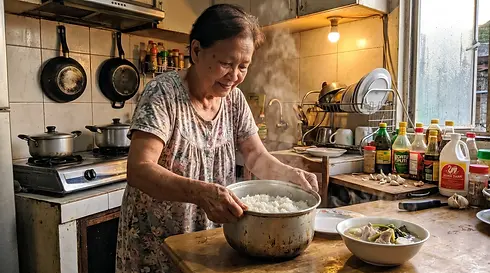
here are recipes that were never written down.
No measurements. No instructions. No printed card inside a recipe box.
Just hands that moved with memory. Just a pinch of this. Just a little more of that. Just the quiet confidence of someone who had made the same dish a hundred times before you were ever old enough to watch.
And somehow… it always tasted exactly right.

We think about those kitchens a lot.
The small ones. The loud ones. The ones that smelled like garlic from the moment you walked through the door.
The kitchens where someone was always cooking something — not because it was a special occasion, but because that was simply how love was expressed in a Filipino home.
You didn't say it with words. You said it with rice. You said it with a bowl of sinigang placed quietly in front of someone who had a hard day. You said it with lechon on the table and every seat filled and no one needing to explain why.
Food was never just food.
It was the language.


There is a particular kind of grief that nobody warns you about.
It is not the grief of losing someone.
It is the grief of realizing you never asked for the recipe.
That you sat at that table a hundred times and never once thought to write anything down because you assumed the meal would always be there. That the hands making it would always be there. That there would always be more time.
And then one day… you are standing in your own kitchen trying to recreate something from memory. Trying to taste your way back to a place that no longer exists in the same way.
Trying to find home inside a pot.

We have heard this story from so many people who have walked through our doors.
The Ate who drove an hour to eat our sinigang because it reminded her of her Nanay back in the Philippines.
The Kuya who brought his kids to try kamayan for the first time because he wanted them to feel what he felt as a child.
The lola who tasted our lechon and went quiet for a moment before saying — "This is how it used to taste."
That kind of silence says everything.
Because food memory is one of the most powerful memories a person can carry.
It lives somewhere deeper than thought. It lives in the body. In the senses. In the part of you that was formed long before you understood what home even meant.


This is why Filipino food matters so much beyond the plate.


Because every dish carries a story that predates the restaurant.
Adobo that has been adjusted and passed down through generations — each family convinced theirs is the only correct version. (And they are all right.)
Kare-kare that takes all day to make because patience was never negotiable in certain kitchens.
Halo-halo that means something different depending on which province your family came from.
Sinangag fried just the way your grandmother made it — with yesterday's rice and enough garlic to make the whole house smell like morning.
These are not just dishes.
They are documents.
They are proof that people lived, and loved, and fed each other.

At B's, we carry that weight with a great deal of respect.
We know that for many of our guests — especially those who are far from home — a meal here is not simply dinner.
It is a return.
A small but deeply meaningful act of belonging.
A way of saying: I am still connected to where I came from. I still carry this. This is still mine.
We do not take that lightly.
Every dish we prepare is made with the understanding that someone at that table may be eating it with an entire history behind their eyes.


And for those who did not grow up Filipino
Welcome to this table.
Filipino food has a way of making everyone feel like family. Because that is what it was always made for.
Not to impress. Not to perform. But to gather.
To nourish. To say — you matter enough to be fed.


We also think about the recipes that were saved.
The ones a daughter finally wrote down while watching her mother cook for what felt like the hundredth time — but this time, pen in hand.
The ones passed down in group chats now, instead of handwritten notes. The ones photographed mid-cook on someone's phone so nothing would be lost.
There is something beautiful about the way a generation refuses to let a recipe disappear.
How love becomes an act of documentation. How feeding someone becomes an act of preservation.

If there is someone in your life who still cooks the food that raised you
Sit with them. Watch them. Ask them how much. Ask them why. Write it down if you can.
Not because the recipe is what matters most.
But because the act of asking is its own kind of love.
It says: I see what you carry. I want to carry it too.


And if those hands are no longer here
Know that the food still holds them.
Every time you cook it. Every time you taste something that takes you back without warning. Every time you set a table that feels, somehow, like theirs.
They are still there.
Still feeding you.

