

Authentic Cebu Lechon & Filipino Feast House
For Orders/Bookings/INQUIRIES:

FROM OUR KITCHEN
The Tables That Hold Us
On belonging, summer, and why the best thing we ever did was open our doors
Stories from the Heart of B's

Memories Served On A Plate

T
here is something that happens at the beginning of summer that we have never quite found the right words for.
The light changes. Not all at once — gradually, over the first days of June, the evenings get longer and warmer, and people start doing something they do not do in the colder months.

They linger.
They sit at tables longer. They lean back in their chairs instead of forward. They order one more round of whatever they are having and they look around at the people with them and they seem, for a moment, to remember why it is good to be alive.
We notice this every June. We have been noticing it for years.
There is a table near the window at B's Sizzling Kitchen — our people call it the corner table, though it is not technically in a corner — where something interesting tends to happen. People who arrive as strangers, or as acquaintances who have not seen each other in a while, or as colleagues who have never really talked outside of a meeting room, will sit down at that table and, somewhere between the first plate of lechon and the last serving of pancit, become something else.

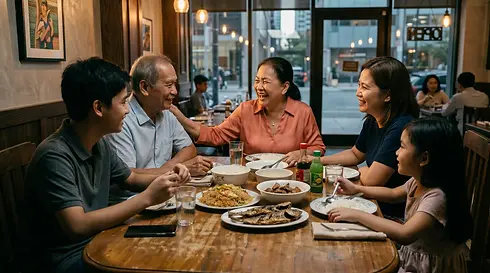

They become people who have shared a meal
It sounds small. It is not small.
We have been thinking a lot lately about what a table actually is. Not the physical thing — the wood, the legs, the surface. But what it represents. What it does to the people gathered around it.A table is permission.
Permission to stop moving. Permission to put down your phone. Permission to eat slowly and talk openly and laugh loudly and be, for the length of a meal, exactly where you are and nowhere else.
In Filipino culture, the table has always been more than furniture. It is the place where news is delivered — both the kind that calls for celebration and the kind that requires silence and presence. It is where grandmothers teach without meaning to, through the specific way they season a dish or the particular order in which they serve. It is where children learn, without a single lesson being announced, that family is not something you are born into so much as something you build, meal by meal, year by year.

"Kumain ka na ba?" Have you eaten yet?

We ask this question every day.
Dozens of times. To guests walking through the door, to people calling in, to anyone who looks like they might need something warm in front of them.
It is not really a question about food.
It is a question about whether you are being taken care of. Whether someone has thought about you today. Whether you are, in the most fundamental sense, okay.
This June, the world comes to Toronto. The FIFA World Cup brings hundreds of thousands of visitors to a city that is already one of the most diverse places on the planet — and for a few weeks, the streets will be filled with people from everywhere, speaking every language, wearing every colour, united by a ball and a game and the particular joy of cheering for something together.


We think about that
We think about our banana leaf table, and we think: this is exactly what Kamayan has always been.
A table where everyone is equal. A spread that belongs to everyone. A meal that asks nothing of you except that you show up and eat and be present with the people beside you.
That is what we want to be this summer.
Not just a restaurant. Not just a caterer. Not just the place with the incredible lechon (though we are absolutely that).
We want to be the table that holds you — whatever you are bringing to it this season.
Whether You Come In
For a Father's Day dinner and watch the World Cup with us.
Whether you order a K-Box for your friends watching the game at home.
Whether you book a summer Kamayan because you have been meaning to all year and you are finally ready.
Whether you just want a plate of adobo and a quiet moment at the corner table.
The table is set. The lechon is in the roaster. The banana leaves are fresh.


